53 Years Later: What the Knicks Championship Teaches Us About Never Giving Up
How belief, fatherhood, adversity, teamwork, and refusing to quit brought New York back to the mountaintop
For fifty-three years, New York waited.
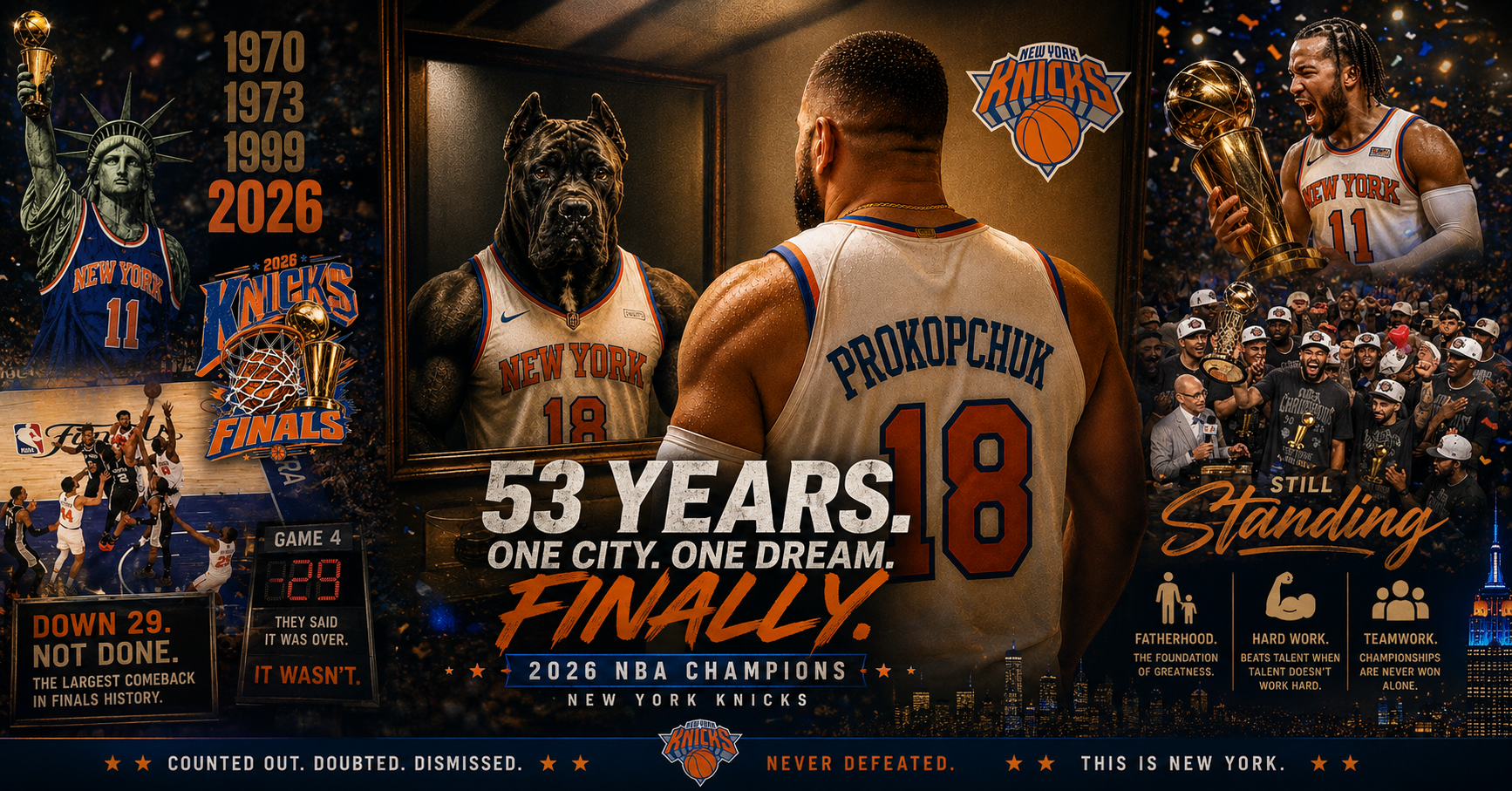
Generations of fans learned to love disappointment. Fathers told sons stories about 1970 and 1973 like family folklore. Grandparents remembered what it felt like to watch a championship parade while younger generations wondered if they would ever see one of their own. The New York Knicks became something larger than basketball: proof that hope can survive even when reality keeps punching you in the mouth.
Then came 2026.
The drought ended.
The banners were no longer memories. Madison Square Garden no longer echoed with stories of what once was. The New York Knicks climbed the mountain again, defeating the Spurs in a Finals matchup that strangely mirrored history. The last time the Knicks had reached the NBA Finals before 2026 was 1999. The opponent? San Antonio.
Some stories take the scenic route.
And maybe that is the point.
Because this championship was not just about basketball. It was about resilience. It was about fathers and sons. About being doubted. About staying in the fight when everyone thinks you are finished. About continuing to show up even when the scoreboard, life, business, and circumstances say you are losing.
The Knicks did not simply win a championship.
They reminded people what perseverance looks like.
Championships are often romanticized after they happen. People remember confetti, rings, and champagne. They rarely remember panic.
The 2026 Knicks spent much of the Finals playing from behind. They were down in game after game, forced to claw their way back through pressure, criticism, and impossible moments.
Then came Game 4.
Down 29 points.
Twenty-nine.
Most teams fold there. Most people fold there.
Yet somehow, the Knicks refused to break. Possession by possession, stop by stop, shot by shot, they climbed back into the game before completing the largest comeback in NBA Finals history, defeating the Spurs 107–106.
That game felt bigger than sports.
Because almost everyone reading this has had their own version of being down 29.
Maybe it was financially.
Maybe emotionally.
Maybe professionally.
Maybe through divorce, loss, grief, health, rejection, or watching dreams collapse in slow motion.
Life has a way of putting impossible scoreboards in front of you.
The question becomes simple:
Do you quit because you are losing?
Or do you keep fighting because the game is not over?
No player embodied that mentality more than Jalen Brunson.
Too small.
Not athletic enough.
Not elite.
A second-round pick. Undervalued. Underestimated.
Critics love certainty. They love labels. They love deciding who people are before the story finishes.
Brunson heard it all.
Yet greatness often arrives wearing the uniform of consistency rather than hype.
He did not become great overnight. He built himself brick by brick through discipline, repetition, humility, and relentless work.
What people often miss is the invisible work behind success.
Everyone wants the spotlight.
Few people want the lonely gym.
Few people want the extra hours.
Few people want the criticism.
Few people want to keep going when the world stops clapping.
That is where champions are built.
With Father’s Day approaching, the Brunson story feels even more meaningful.
Rick Brunson played for the Knicks during their last Finals appearance in 1999. Decades later, his son brought the championship back.
There is poetry in that.
But there is also something deeper.
Fathers matter.
Guidance matters.
Standards matter.
Hard conversations matter.
Discipline matters.
Rick Brunson pushed his son hard. Not because he wanted to break him, but because he understood something painful about greatness:
The world will test you harder than a loving father ever could.
Strong fathers help sons build resilience.
They teach accountability.
They teach how to respond when life punches first.
That lesson stretches beyond basketball.
A father’s presence can shape confidence, discipline, emotional security, and belief. It does not guarantee success, but it can create a foundation sturdy enough to survive storms.
Championship teams are rarely assembled from people who had easy lives.
Many Knicks players endured setbacks, criticism, injuries, trades, and personal hardship. Behind every locker room celebration sits a quieter reality: sacrifice.
Professional sports teach a brutal lesson.
Nobody cares about your excuses.
Nobody hands you anything because your road was difficult.
Pain can either become a prison or fuel.
The Knicks chose fuel.
And that applies to life too.
Success rarely belongs to the most naturally gifted person.
It often belongs to the person who simply refuses to stop.
There is a dangerous myth in business.
People think successful people never struggled.
That winners always knew the outcome.
That confidence means certainty.
The truth?
Most successful people spend years doubting themselves while moving anyway.
The Knicks’ championship offers lessons that apply far beyond basketball:
1. Stop quitting too early.
Many people abandon goals while they are still in the first quarter of life.
2. Teamwork multiplies outcomes.
No championship is won alone. Business works the same way.
3. Ignore the noise.
Critics rarely build anything meaningful.
4. Keep showing up.
Consistency compounds.
5. The job is not finished.
The Knicks refused to celebrate early. Greatness often comes from delayed gratification.
As someone who immigrated from Ukraine with family, rebuilt through adversity, navigated personal setbacks, career uncertainty, fatherhood, loss, and rebuilding, this story lands differently for me.
Life does not always go according to plan.
Sometimes you lose things you thought would last forever.
Sometimes you must rebuild from the ground up.
Sometimes people underestimate you.
Sometimes doors close.
Sometimes you are down 29.
But there is power in still standing.
There is power in refusing to stay down.
My own journey has included hardship, rebuilding, fatherhood, entrepreneurship, career pivots, and learning how to keep moving when life becomes uncomfortable. Through the Digital Savage Experience and everything I continue building, one truth keeps surfacing:
Resilience matters.
Faith matters.
Showing up matters.
Believing matters.
Especially when nobody else does.
The Knicks did not just win a championship.
They restored belief.
They reminded people that timelines do not matter if you refuse to quit.
Fifty-three years sounds impossible until it finally happens.
The lesson is not to wait fifty-three years for success.
The lesson is to stop assuming delay means defeat.
Sometimes the breakthrough comes after years of disappointment.
Sometimes the comeback starts when everyone stops believing.
Sometimes the story gets better precisely because it took so long.
The Knicks were down 29 and still found a way.
Maybe that is the message.
No matter what scoreboard life puts in front of you:
Keep fighting.
Keep believing.
Keep working.
The game is not over.

Podcast Host - Agency Founder - Ukrainian Immigrant - Believer
Roman is a 1st generation immigrant from Lviv, Ukraine. He arrived in the US with 6 other family members to a 2 bedroom apartment. Roman interned with the Secret Service and held a top secret government clearance. He was forced to become a self taught digital marketer as a result of the 2008 recession, and fell in love with it. Roman has 18 years of experience leading digital teams in senior leadership roles on over 700 campaigns across many industries. He founded Nova Zora Digital in 2012. Roman is the host of the Digital Savage Experience Podcast and previously a Co-Host of Real Talk Podcasting a Top 50 Podcast on Apple Podcasts for Entertainment News. He is a adoptive and foster parent, and has fostered 29 kids in the span of 4 years.

Comparison Is the Thief of Joy: The Silent Trap Stealing Your Life


