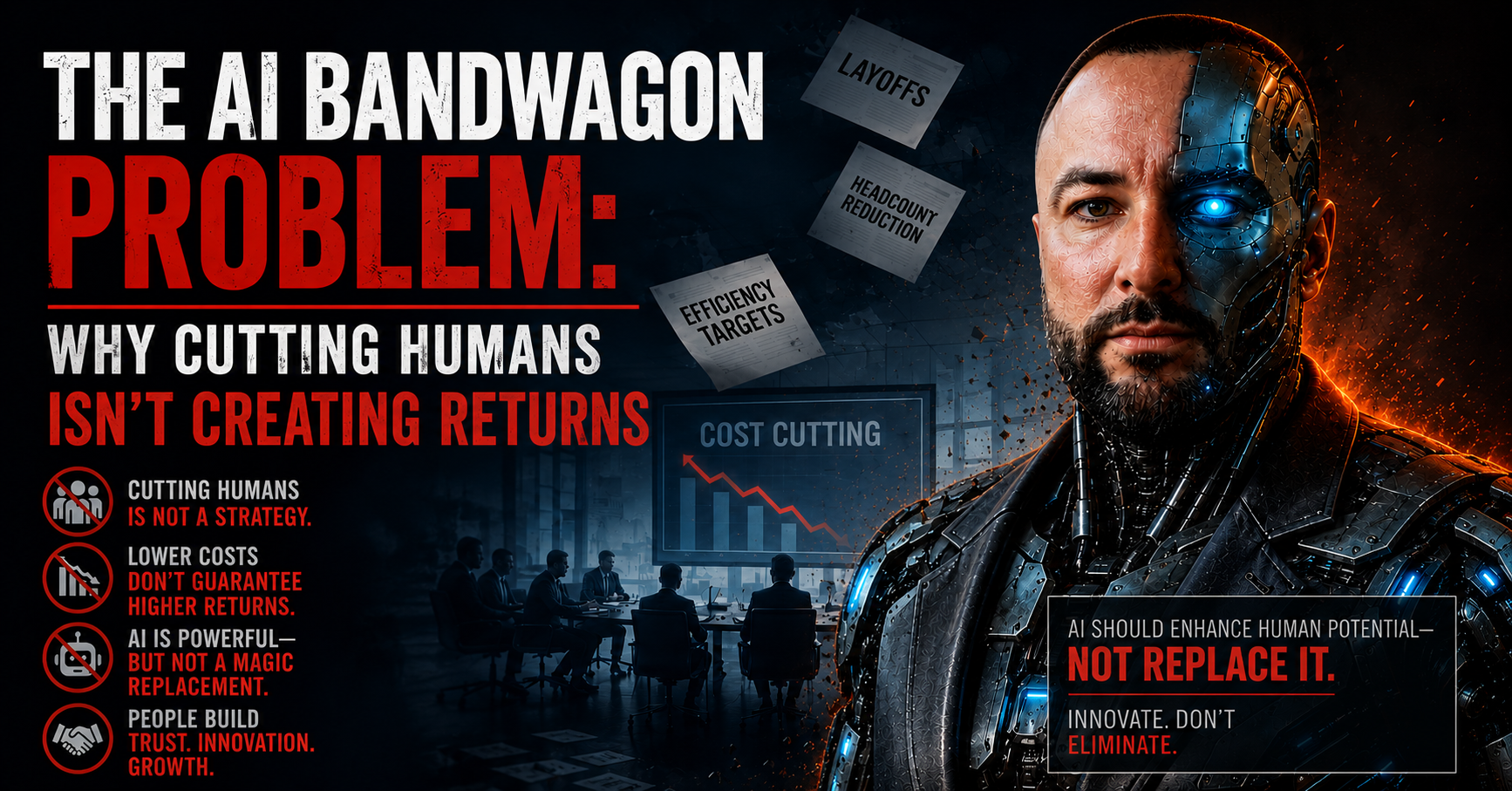
The AI Bandwagon Problem: Why Cutting Humans Isn’t Creating Returns
The Dangerous Corporate Mistake of Confusing Cost-Cutting with Innovation
Everyone wants to be an AI company.
Boardrooms are suddenly flooded with AI slide decks. CEOs are racing to drop the phrase “AI-first” into earnings calls. Entire departments are being gutted under the banner of efficiency. Workers are being replaced, payrolls slashed, and executives are celebrating “transformation.”
There is just one problem:
Cutting humans is not a growth strategy.
Right now, corporate America is running one of the biggest business experiments in modern history, and many companies are learning the hard way that replacing people with artificial intelligence is not automatically creating better businesses, stronger margins, happier customers, or greater shareholder returns.
In fact, evidence increasingly suggests the opposite.
The uncomfortable truth no one wants to say out loud is this:
Many companies are not using AI to innovate. They are using AI as camouflage for short-term cost-cutting.
And in the process, they may be sacrificing the very thing that built their business in the first place: people.
The AI Gold Rush Mentality
Every major technological revolution creates winners, losers, and irrational behavior.
The internet boom had companies adding “.com” to their names just to inflate stock prices. Crypto created an era where firms launched blockchain strategies without a single practical use case. The metaverse became a billion-dollar buzzword before reality ever caught up to the pitch.
Now we are living through the AI version of that same psychology.
Fear is driving decision-making.
Executives fear being left behind. Investors fear missing the next wave. Employees fear replacement. Companies fear appearing outdated.
And fear makes people irrational.
Instead of asking, “Where can AI improve our business?” many organizations are asking, “How fast can we cut labor and tell Wall Street we’re leveraging AI?”
That distinction matters.
Because there is a massive difference between using AI to improve productivity and using AI to eliminate institutional knowledge.
One creates competitive advantage. The other creates instability dressed up as innovation.
The current AI obsession has created a dangerous herd mentality where companies are copying one another without fully understanding whether the economics actually work.
Being “AI-first” sounds visionary.
But if your strategy begins and ends with layoffs, that is not innovation.
That is financial engineering with a chatbot attached.
Cost Reduction Is Not Revenue Growth
This is where the math starts to break down.
Many executives are treating labor reduction as proof of transformation.
“We reduced headcount by 20%.”
“We automated operations.”
“We replaced teams with AI.”
Great.
Where is the revenue growth?
Because here is the reality few executives want to admit:
You cannot cut your way into long-term relevance.
You can temporarily improve margins. You can manufacture a better quarter. You can create a cleaner earnings story.
But eventually, businesses are judged on something far more difficult: growth.
Customer retention. Product quality. Innovation. Market share. Trust.
And according to emerging research, many companies making aggressive AI-related workforce cuts are not seeing improved financial returns at all.
One report found that while companies aggressively reduced staff in favor of AI systems, those moves failed to materially improve returns. In some cases, businesses experienced little to no measurable performance gain despite significant restructuring.
That should set off alarms.
Because if the tradeoff is lower payroll, lower customer experience, stagnant growth, and flat returns, then what exactly are companies optimizing for?
Optics?
Temporary margin expansion?
Executive bonuses tied to short-term performance?
Here is the brutal truth:
Cost-cutting without revenue expansion is corporate dieting.
You might lose weight quickly. But eventually, you become weaker.
The Dirty Secret Nobody Wants to Admit: AI Is Expensive
The biggest myth in business right now?
That AI is cheaper than people.
In theory, maybe.
In reality? Not even close.
Executives love to compare an employee salary against a software subscription.
That comparison is fantasy math.
Because AI is not just software.
AI comes with massive compute costs, cloud infrastructure expenses, GPU demand, licensing fees, integration costs, governance requirements, security risks, hallucination monitoring, compliance oversight, human quality control, and constant retraining.
You are not replacing labor with a magic robot.
You are replacing labor with an expensive digital workforce that still requires humans to supervise it.
Even leaders deeply embedded in AI are beginning to wave warning flags.
Executives tied to Nvidia, one of the biggest beneficiaries of the AI boom, have openly acknowledged a hard truth: in many scenarios, the cost of compute is exceeding the cost of employees.
Think about how absurd that should sound.
The companies selling the picks and shovels during the AI gold rush are quietly saying, “This may not actually save money.”
Yet businesses continue sprinting toward mass replacement strategies as though the economics are already solved.
They are not.
Most firms are still experimenting. Many are still burning money. And some are quietly discovering that AI savings disappear once you account for errors, oversight, implementation, and customer fallout.
The spreadsheet looked brilliant.
Reality had other plans.
The Great Corporate Walk-Back
This is where the story gets interesting.
Because companies that loudly announced AI-driven workforce reductions are now quietly rehiring humans.
Not because they became anti-AI.
Because reality hit.
Klarna: Efficiency Collided With Customer Trust
Klarna became one of the poster children of the AI-first movement.
The fintech giant reduced hundreds of customer service roles while heavily promoting AI chatbots as the future.
Then came the consequences.
Customer frustration increased. Complex issues remained unresolved. Satisfaction declined.
Eventually, Klarna began actively bringing human support talent back into the business.
Turns out customers do not love talking to a machine when their money is involved.
Trust still matters.
IBM: The Empathy Problem
IBM aggressively automated portions of HR through internal AI systems.
But human resources turns out to be, inconveniently, very human.
Employees dealing with career concerns, workplace issues, compensation conflicts, or emotional complexity often require nuance, judgment, and empathy.
Not canned responses.
IBM ultimately redirected resources into human-facing engagement and strategic functions.
Because people problems rarely fit inside clean algorithmic boxes.
Duolingo: Creativity Cannot Be Automated Into Existence
Duolingo leaned heavily into AI-generated educational content.
Freelancers were cut. Automation accelerated.
Then users noticed something.
The content felt flatter. Less nuanced. Less human.
Language is culture. Humor. Context. Emotion.
AI-generated efficiency began colliding with the reality that human creativity still matters.
And rehiring followed.
Big Tech’s Quiet Reversal
Google. Meta. Salesforce.
The layoffs were loud.
The rehiring was much quieter.
Many companies discovered something executives rarely say publicly:
AI often creates new human jobs instead of eliminating them.
Content moderation. Prompt engineering. Governance. Quality assurance. Brand oversight. Human verification. Compliance. Editorial review. Technical monitoring.
The irony is impossible to ignore.
The technology marketed as a labor replacement frequently requires additional labor to function effectively.
McDonald’s: When Nuggets Become a Crisis
Few stories illustrate AI overconfidence better than automated drive-thru ordering.
McDonald’s tested AI ordering systems across U.S. locations.
Then came the viral failures.
Incorrect orders. Customer confusion. Massive mistakes.
One infamous example involved wildly inflated food quantities that turned ordering into internet comedy.
Eventually, the experiment was pulled.
Humans returned.
Because speed means nothing if accuracy collapses.
Customers do not care that your margins improved if their dinner order looks like chaos.
The Shareholder Trap
There is another uncomfortable reality here.
Some executives are using AI as a narrative device.
Wall Street rewards efficiency stories.
“AI transformation” sounds powerful.
“Strategic workforce optimization” sounds visionary.
“Reduced labor dependency” sounds innovative.
The stock pops. Analysts cheer. Margins temporarily improve.
But here is the problem:
Shareholders eventually ask harder questions.
Where is the growth? Where are the new customers? Where is the pricing power? Where is the product innovation? Where is the loyalty?
Because eventually, financial engineering runs out of runway.
You cannot endlessly shrink your way to greatness.
A business stripped of expertise, creativity, institutional knowledge, and customer empathy may become leaner.
But it may also become weaker.
There is a dangerous assumption happening right now: that workers are simply interchangeable cost centers.
They are not.
Many employees carry invisible value: relationships, historical knowledge, problem-solving ability, pattern recognition, creativity, emotional intelligence, and brand stewardship.
The irony?
Many executives will not realize what they lost until after those people are gone.
And by then, rebuilding trust, culture, and execution becomes exponentially harder.
What Smart Companies Will Actually Do
The winners of the AI era will not be the companies that fire the fastest.
They will be the companies that think the smartest.
The strongest businesses will understand a critical distinction:
AI works best as an amplifier, not a substitute.
The real opportunity is not human or machine.
It is human plus machine.
Augmentation Over Replacement
Use AI to remove repetitive work, not eliminate judgment.
Give employees leverage.
Let marketers analyze faster. Let engineers code faster. Let support teams resolve issues faster.
But keep humans where trust and nuance matter.
Revenue Expansion Over Labor Elimination
Productivity gains should fuel growth.
More customers. Better products. Faster innovation. Improved personalization. Expanded services.
Not just lower payroll.
If AI saves 30% of time, the smartest leaders ask:
“How do we grow 30% faster?”
Not:
“Who do we cut?”
Human Governance Becomes the Advantage
The future is not fully autonomous systems.
It is governed intelligence.
Businesses that combine AI efficiency with strong human oversight will outperform firms blindly automating everything.
Because trust becomes a competitive advantage.
And trust still belongs to humans.
Conclusion: Don’t Confuse a Chainsaw for a Growth Strategy
AI is real. Transformational. Powerful. And undeniably important.
Companies that ignore it will fall behind.
But companies blindly worshipping it may be making an equally dangerous mistake.
Because there is a growing difference between using AI strategically and using AI recklessly.
Right now, too many businesses are confusing labor elimination with innovation.
They are chasing short-term efficiency at the expense of long-term capability.
Cutting expertise. Removing institutional memory. Weakening customer relationships.
And calling it progress.
History has a habit of humbling people who confuse hype cycles with durable economics.
The companies that ultimately win this era will not be the ones that replaced humans fastest.
They will be the ones that figured out how to make humans exponentially better.
Because despite every headline, every earnings call, and every AI press release:
A chatbot is not a business model.
And a layoff is not a growth strategy.

Podcast Host - Agency Founder - Ukrainian Immigrant - Believer
Roman is a 1st generation immigrant from Lviv, Ukraine. He arrived in the US with 6 other family members to a 2 bedroom apartment. Roman interned with the Secret Service and held a top secret government clearance. He was forced to become a self taught digital marketer as a result of the 2008 recession, and fell in love with it. Roman has 18 years of experience leading digital teams in senior leadership roles on over 700 campaigns across many industries. He founded Nova Zora Digital in 2012. Roman is the host of the Digital Savage Experience Podcast and previously a Co-Host of Real Talk Podcasting a Top 50 Podcast on Apple Podcasts for Entertainment News. He is a adoptive and foster parent, and has fostered 29 kids in the span of 4 years.

Comparison Is the Thief of Joy: The Silent Trap Stealing Your Life


